
Safer Streets Now: How Brookline Can Learn from its Neighbors to Achieve Vision Zero

Louisa Gag’s Ghost Bike, installed in her memory along Tremont Street in Boston. Photos courtesy of Peter Cheung.
On July 9, 2026, Louisa Gag was biking to work when the driver of a truck struck and killed her near Roxbury Crossing in Boston. Louisa was a transportation planner for the City of Boston and was deeply involved in the city’s efforts to make streets safer.
Just 13 days prior, LivableStreets published its 2026 Vision Zero Progress Report, which evaluated Somerville’s, Cambridge’s, and Boston’s progress toward eliminating crashes that result in deaths or serious injuries. Somerville grabbed headlines due to its impressive progress, including registering zero fatal crashes since 2022 and a steady decline in serious crashes over the past decade. And though this progress is encouraging, clearly much work remains across metro-Boston.
In the wake of Louisa’s death, Boston-area communities and beyond are seeking to rapidly address longstanding roadway safety issues. Nearly every year, someone dies in Brookline from a roadway crash and hundreds more are injured. As the Town implements safety-improvement measures, it can learn from the experiences in Somerville, Cambridge, and Boston, which have been working toward Vision Zero for a decade.
This article is the first of several looking at Vision Zero efforts across the region and it provides an initial overview of where Brookline stands in relation to the three more experienced cities.
How do Roadway Crash Trends Compare?
Since Somerville, Cambridge, Boston, and Brookline vary greatly in size, their total crash counts aren’t directly comparable. Instead we can look at their relative crash trends over the past decade using MassDOT’s Crash Data Portal, which, despite some limitations is the most comprehensive source available.
Since 2014, Somerville and Cambridge broadly reduced overall roadway crashes while crashes in Boston and Brookline increased. The COVID-19 pandemic resulted in reduced crashes across all municipalities in 2020, but Somerville and Cambridge were able to maintain those reductions as their Vision Zero implementation efforts took root. In Boston and Brookline, crashes quickly rebounded.
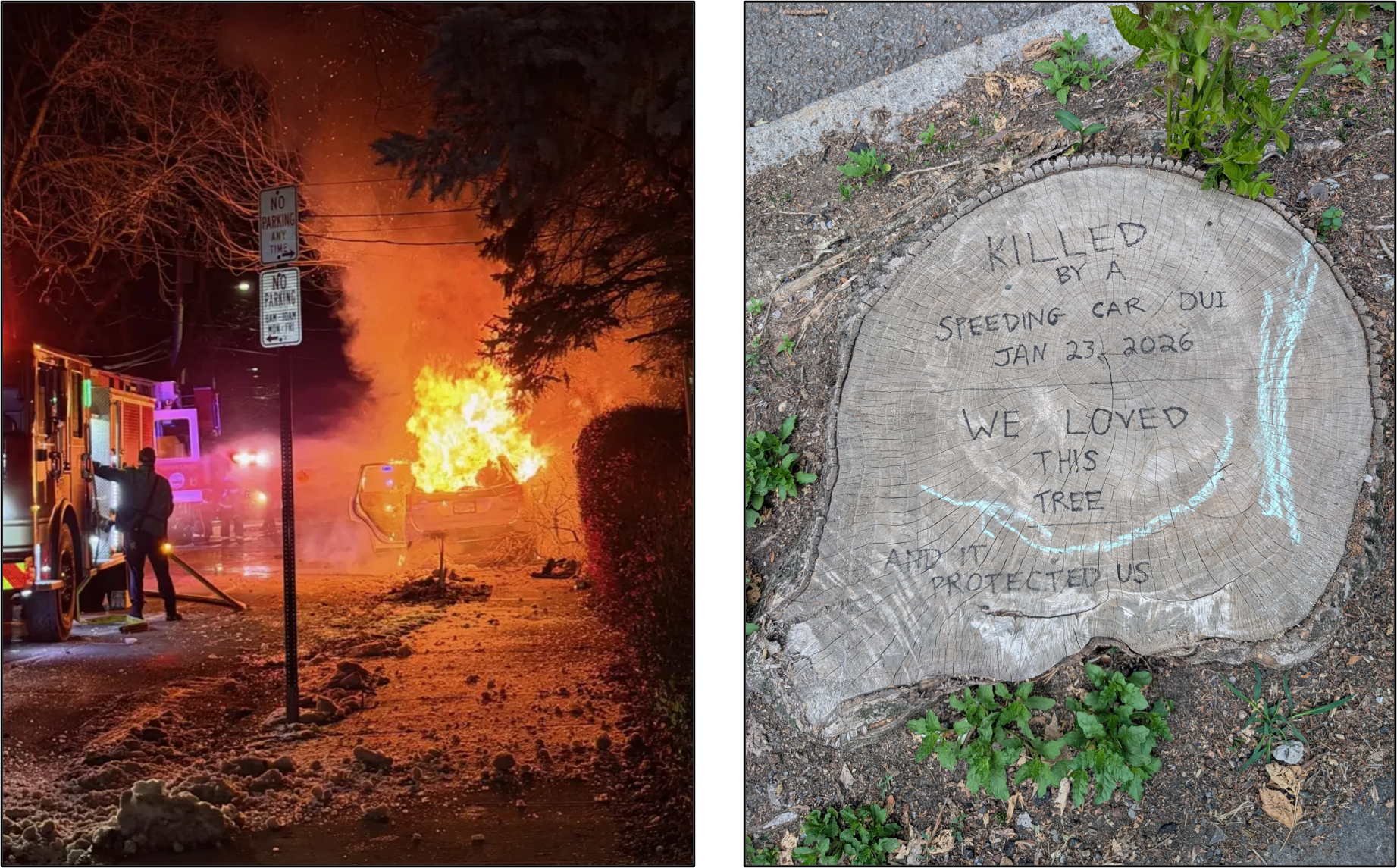
A car crashed into a tree on Aspinwall Avenue in Brookline on January 23, 2026. The driver fortunately survived, but the tree that was struck needed to be cut down. First photo courtesy of Brookline Police Department, second photo courtesy of Gregory Wheeler.
Are Streets Getting Safer for Vulnerable Users?
Assessing street safety requires evaluating trends in crashes against changes in mode utilization (driving, walking, biking).
For this article, I focused on bicycle safety to see whether there are clear trends across the four municipalities. If bicycling is getting safer, we should expect to see some mix of increased ridership coupled with stable or decreasing crash rates.
Somerville & Cambridge: Leading the Way
Somerville and Cambridge both made substantial progress in improving bicycling safety.
Prior to Somerville’s Vision Zero Action Plan, which launched in 2020, bicycle ridership and crashes fluctuated each year. However, the city’s sustained efforts to improve bicycle safety coming out of the COVID-19 pandemic helped rapidly increase bicycle ridership compared to crashes. By 2025, Somerville’s bicycle ridership increased by 11% from 2014 baseline levels while crashes involving bicycles declined by 36%.
Cambridge began its Vision Zero efforts a few years before Somerville and since 2014, bicycle ridership is up 36% in the city. During that period, crashes involving bicycles declined by 4%, indicating that a sustained approach to Vision Zero can result in long-term ridership gains and safety improvements.
Boston: Stalled Progress
Boston was one of the first cities in the country to adopt a Vision Zero policy. Over the past decade, bicycle ridership increased 54%, and for several years, crashes involving bicycles declined. However, in 2025, Boston’s Mayor stalled several bicycle safety projects (and removed some existing measures). Crashes increased substantially and ultimately outpaced the long-term growth in ridership rates.
Brookline: Playing Catch-Up
Over the past decade, crashes involving bicycles fluctuated widely in Brookline, and were 44% higher in 2025 than in 2014. Though the Town periodically conducted bicycle counts in the past, it doesn’t maintain a database that is sufficiently comparable to the other cities. As such, we’re unable to see ridership trends compared to crashes.
Brookline only adopted its Vision Zero Action Plan in 2025, but it doesn’t need to remain five to ten years behind its neighboring cities in improving safety; it can learn a great deal from each city’s efforts over the past decade.
What Worked and What Didn’t?
Since adopting their Vision Zero policies, Somerville and Cambridge each strengthened their approach by passing binding ordinances that mandate they build dozens of miles of protected bicycle lanes (30 miles by 2030 for Somerville, 25 miles by 2027 for Cambridge, or 20% to 30% of each city’s street network) and add compliant protected infrastructure “whenever improvements are made to a public street.” These mandates empowered each city to move from abstract plans to implementation.
With binding ordinances in place, Somerville and Cambridge each aggressively installed dozens of miles of protected bicycle lanes along with targeted traffic calming measures throughout neighborhoods that slowed motor vehicle speeds. Speed humps, curb extensions, and raised crosswalks / intersections were the most effective approaches used by Somerville. This obligatory city-wide commitment helped quickly create a robust network of infrastructure that encouraged more people to safely ride bicycles for their daily activities.
Boston presents a cautionary tale. Following significant increases in bicycle ridership, the city stalled - and even sometimes removed - safety improvement measures in 2025. This exposed a much larger group to unsafe conditions and crashes involving bicycles spiked.
What Can Brookline Do Next?
Achieving Vision Zero requires a long-term commitment and a coordinated approach. Brookline is off to a late start, but over the past decade the Town already identified, prioritized, and documented its safety-priority streets in numerous policy and planning documents (see note below). It now has an opportunity and an imperative to significantly expand its protected bicycle infrastructure.
Note: In addition to its Vision Zero Action Plan, Brookline also maintains a Complete Streets Policy; Green Routes Bicycle Network Plan; Traffic Calming Policy; Transportation & Mobility Plan; and Crosswalk Policy & Design Guidelines.
1. Install Quick-Build Protected Lanes on Highest Priority Streets During Planned Roadway Maintenance
Brookline currently has less than a mile of protected bicycle lanes along the 100 miles of roadway it manages, but the next five years presents a window to efficiently change that. By 2031, the Town plans to pave nearly 6 miles of streets that are also among its highest Vision Zero priorities (categorized as Tier 1 or Tier 2 in Brookline’s Vision Zero Action Plan). Adding flexposts and/or parking-protected bicycle lanes during this planned work - even on parts of these streets - is the most realistic way to begin catching up with the successes seen in Somerville and Cambridge.
Quick-build protected lanes may be an imperfect solution, but if done at scale, such incremental improvements can significantly and cost-effectively improve safety while the Town also tackles more substantial investments along major corridors like Beacon Street and Washington Street.
2. Enforce Speed Limits with Roadway Design using Speed Humps
Protected bicycle lanes aren’t necessary or feasible on all of Brookline’s Vision Zero streets. In these cases, speed humps can significantly improve safety by forcing motor vehicles to adhere to the Town’s 20 mph Safety Zone speed limit. This speed - roughly twice that of a bicyclist - is much safer for bicycles when they share a lane with cars.
Speed humps aren’t the only method to slow traffic (raised intersections, curb extensions, and chicanes are also effective) but they can be installed quickly without requiring expensive alterations to curbs. In fact, in spring 2026, Brookline took this approach to a cluster of five roads. With a construction cost of only $410,000, the Town is now effectively and automatically enforcing the speed limit on nearly 3.5 miles of its streets.
3. Inform Policy Decisions with Data, Analysis, & Transparent Updates
Somerville, Cambridge, and Boston each have a story to tell about Vision Zero because they methodically collected and reported on relevant data over the past decade. Producing layered analysis of reliable data creates the foundation for informed policy and operating decisions.
4. Mandate Safety Standards, Goals, and Timelines - and Fund Accordingly
To add legal weight to their plans, Somerville and Cambridge mandated clear standards, goals, and timelines for safety improvements. The cities face serious legal challenges if they don’t achieve their goals, and the ordinances make it much more difficult for a Mayor to unilaterally halt progress.
As a Town, Brookline’s legal equivalent to ordinances are its By-laws, which can be changed through a vote at Town Meeting. Amending By-laws can be a challenging process, but doing so would help Brookline hold itself accountable for its extensive (though non-binding) plans to improve safety.
Transformation is never easy and altering roadways will require difficult decisions, but Brookline shouldn’t wait to make substantial safety improvements. The Town can leverage much from Somerville, Cambridge, and Boston - and it can honor Louisa Gag by learning from her impactful work and incredible life.